HOME INQUIRY BLOWERS FANS AHU HVAC CONTACT |
INDUSTRIAL
BLOWERS CO.
Tenderall Co. makes two primary gas-fired AHU types: direct gas-fired and indirect gas-fired air handlers.
DIRECT GAS-FIRED AHU
A direct gas-fired AHU has a gas burner installed
directly in the outside makeup-air stream. The products of combustion
(carbon dioxide [CO
INDIRECT GAS-FIRED AHU
An indirect gas-fired AHU has a sealed combustion chamber where all products of combustion are discharged through a flue to the outside environment and no products of combustion are discharged within the make-up air supplied to the building. Such airhandler also frequently is utilized for recirculating-air applications.
DIRECT-GAS-FIRED-AHU COMPONENTS
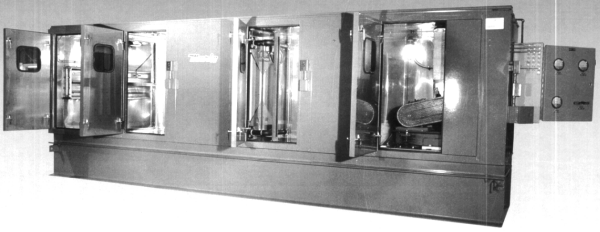
Though simple in principle of operation, Canada Blower direct gas-fired AHUs have sophisticated burner-control systems. AHUs sizes range from 1,000 cfm with a heating capacity of 80,000 Btuh to 100,000 cfm with a heating capacity of 15 million Btuh. Direct-gas-fired-AHU components usually include housings, supply fans, outside air intake hoods, intake dampers, filters and burners.
AHU HOUSINGS
AHU housings are made of galvanized or aluminized steel.
Access panels are provided to access dampers, filters, burners, and
fans / motors. AHUs located outside are provided with a sloped roof and
standing seam joints.
SUPPLY FANS
Fans typically are double-width double-inlet (DWDI) with forward-curved or backward-inclined blades. Fans can come with open drip-proof (ODP) or totally enclosed fan cooled (TEFC) motors. The most typical external static pressure in the 2- to 3-in.-wg range. Because most outside istalled air handling units can operate below 0°F, fan motors and bearings are rated to handle lower temperatures. For applications that require supply-air temperatures higher than 110°F, the motors and fan bearings are rated for maximum design operating temperatures when placed in draw-through configurations.
INTAKE DAMPERS AND HOODS
Outside air intake hoods or weather hoods are designed for an installation specific location and usually provided with bird screens. Outside-air intake isolation dampers are furnished to prevent cold air from dropping through a unit into a warm building and warm air from escaping through a unit during winter months, when it is not in operation. Low-leakage parallel blade isolation dampers are most standard. The fan discharge is located at the opposite to isolation-damper position.
FILTERS
A filter cabinet normally has 30/30 filters in a V-bank configuration to increase filter area and reduce static-pressure drop across the filters. Higher-efficiency filters are used on application.
BURNERS
Canada Blower burner consists of a cast-iron or aluminum
pipe
assembly with
drilled gas orifices. The fuel-air mixing is controlled by perforated
stainless-steel baffles attached to the pipe assembly. The burner can
be placed in the outside airstream or in the outside / return mixed-air
stream. But to prevent potentially hazardous combustion byproducts of
indoor-air contaminants, the burner is placed in the outside airstream
only. The required airflow across the burner must be within a specific
velocity range (typically 2,500 to 3,500 fpm) for proper combustion.
For variable airflow units, a modulating bypass damper or profile plate
maintains the airflow velocity within the specified velocity range.
Otherwise, the burner can experience inefficient operation, generate
odors in the occupied spaces served, and create an un-safe increase in
certain products of combustion.
CAPACITIES: Up to 100,000 CFM for standard construction and larger, custom made on special request.
FLEXIBILITY: Every air handling unit is designed for the specific installation and connections conditions. The AHU floor area and its cross section dimensions are adjusted for precise room available at site.
EASY INSTALLATION: Packaged compact or sectional air handler design provided with lifting arrangement and protections for easy transportation and handling / installation at site.
OPERATIONALLY SAFE: Safety devices and guards are provided in accordance to the international regulations and the customer specific requirements.
PRECISE PERFORMANCE: To match the customer capacities requirement utilizing
the computerized selection for each AHU component.
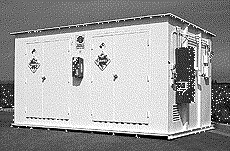
Canada Blower Industrial HVAC products:
Standard industrial-grade equipment
Custom designs
Indoor or rooftop
Multiple air filtration efficiency options
Responsible energy reduction
Noise attenuation options
Expected Air Handling Unit Performance
Canada Blower standard equipment includes:
Direct-fired make-up air units to 85,000 CFM
Indirect-fired make-up air units to 57,000 CFM
Air turnover (air rotation) units to 100,000 CFM
Air Handling Unit Terminology
Make-Up Air
Air Rotation
Evaporative, DX or chilled water cooling
Door heaters
Gas or electric heating
Heat recovery
Large Building Ventilation Applications
Applications for large space ventilation are numerous:
Rolling mills
Poultry Houses
Fruit and Produce Storage Facilities
Foundries
Shale Gas Compressor Stations
Warehouses
Motor Room Ventilation
Canada Blower components for Large Building Ventilation Projects
Components for the ventilation system:
Supply and Exhaust Fans – in wall or roof configurations
Cooler Fan Silencers
Louvers, Dampers & Diffusers
Side Access Filter Housings
Ridge Vents
Intake Hoods -weather and gooseneck designs
SysTech custom Ventilation Modules
Electric Unit Heaters
EXP Unit Heaters – catalytic, electric or hot water
HVAC Units
EXP Gas detection Purge Systems
Electrical Control Packages
Buildings may be steel pre-engineered, brick, block, or brick construction, typically with roof exhaust and wall supply openings, with fan-powered ventilation modules moving large volumes of air. Canada Blower has designed ventilation projects using the principles of air changes per hour, dilution of concentrated contaminants, or source capture of a pollutant. Air change and dilution designs employ passive or natural ventilation or active or mechanical ventilation techniques.
Each ventilation design package is tailored to available utilities, local weather conditions, hazardous and/or explosive nature of the conveyed gases, ambient air quality, occupational safety and comfort, number of personnel on-site, noise criteria and specific requirements.
For competitive quotations click here:

Explosion proof backwardly inclined; airfoil; Canada Blower radial and radial-tip fans and blowers. Pressure blowers; plug fans; air kits; centrifugal and axial ventilators; acid resistant blowers, agitation and aeration FRP and Propylene blowers, blower filter units, blower filters, blower repair and rebuild, Barron, fan and blower balancing, fan and blower wheels and impellers, air jet blowers and systems, axial blowers, cooling blowers and fans, corrosion resistant blowers, fiberglass reinforced plastic and PVC blowers and fans, furnace fans and blowers, mobile and package fans and blowers, manhole fans and blowers, electric and gasoline motor driven fans and blowers High temperature fans from Canada Blower can withstand temperatures up to 2200 F° or 1200 C°. These Super high temperature fans are offer as centrifugal amongst other types.
industrial pressure blowers, commercial fans, high-temperature industrial pressure blowers, Canadian Blower pressure blowers Canadian Blower OEM industrial fans, roof and wall exhausters, ventilating and air-conditioning equipment, pressure blower HVAC, heating ventilation and air conditioning, process and OEM blowers, Canadian Blower custom
built fans, ventilators, dust collectors, combustion pressure blowers.
Industrial & OEM fans, blowers, ventilators, pressure blowers and high temperature fans. Sales of centrifugal & axial fans and blowers, industrial process fans, building ventilators, dust collecting fans. Supplier of radial blowers, vaneaxial & tubeaxial ventilators, explosion proof spark-resistant fans, fiberglass FRP, PVC and Propylene blowers, oven circulating super high temperature fans. Designers of air tight sealed blowers, stainless steel, aluminum and special alloy fans, super high pressure centrifugal, regenerative, side channel and multi-stage blowers, high volume ventilators. Engineering of air moving and industrial ventilation equipment, combustion blowers, material handling and pneumatic conveying fans, inline direct & belt driven ventilators. Distributors of Chicago Blower, American Coolair / ILG NYB TCF fans, wall & roof exhaust and supply power ventilators, panel propeller fans, gas-fired direct and indirect make-up air handling units AHU, air curtains and blow-off air knives and air-knife systems, fan silencers, corrosion-resistant ventilators, positive pressure ventilators, mobile macoolers, reversible duct ventilators, fan dampers and louvers.
ventilating.com fanblower.com highpressureblower.net industrialblowerfan.com industrialfanblower.net industrialfanblower.com pressureblower.net northernindustrialsupplycompany.com industrialpressureblower.com tenderall.com chicagoblowercanada.com cbblower.com buffaloblower.com buffalofan.com nis-co.com canadianblower.com olegsystems.com canadablower.com abbblower.com acmefan.net industrialblower.net fansandblowers.net americanblower.net barryfan.com cincinnatifan.net canadafans.com barryfan.net pennbarry.net pennfan.net tcffan.com
The airflow requirement for an industrial process broadly depend on the operational conditions, material to be handled and system resistance. When airflow of a fan system is not adequate, typically industries seek alternatives such as increasing the fan speed or replacing it with a bigger capacity equipment.
To avoid facing issues associated with system airflow, industries have to ensure proper working of their centrifugal fan system. By employing certain maintenance procedures such as checking fan mechanical conditions and performingperiodicinspection of system components, the issues with system airflow can be rectified.